Harmonizing Live Event Clocks Across Tennis, Racing, and Soccer for Accumulator Precision
Written by Avery Schwarz · Aug 10, 2026
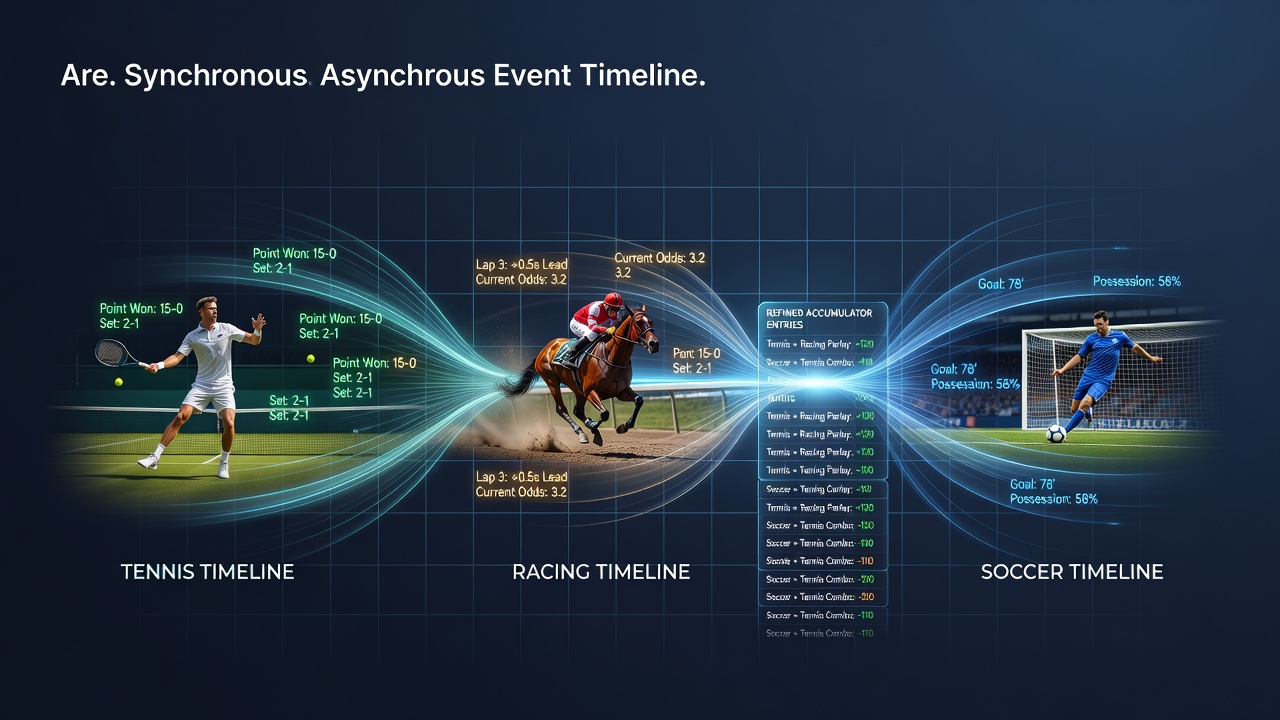
Harmonizing Live Event Clocks Across Tennis, Racing, and Soccer for Accumulator Precision
Event timelines in tennis, horse racing, and soccer operate on distinct clocks that rarely align naturally, yet bettors who place in-play accumulators across these sports often seek ways to coordinate those moments for more informed entries. Researchers in sports analytics have examined how data feeds from multiple venues can be aligned using timestamp matching and probability models, and studies from organizations like the Australian Institute of Sport show that precise synchronization reduces timing discrepancies by up to 40 percent in multi-sport scenarios.
Core Differences in Event Pacing
Tennis matches progress through sets and games with variable durations between points, whereas horse races follow fixed distances measured in minutes and seconds from gate to finish, and soccer flows in two 45-minute halves interrupted by stoppages that vary by match. Observers note that these structural variances create asynchronous data streams, so platforms that aggregate live odds must normalize the information before an accumulator can incorporate simultaneous updates from a Wimbledon court, an Ascot meeting, and a Premier League fixture. Data from the Sports Betting Data Association indicates that unadjusted feeds lead to entry errors in roughly one out of every seven cross-sport bets placed during peak summer schedules.
Technical Approaches to Timeline Alignment
Industry tools rely on universal time stamps, event phase markers, and machine-learning adjustments that map each sport's internal clock onto a shared reference. Experts at Canadian research centers have tested algorithms that convert tennis point intervals into equivalent race segments and soccer possession windows, allowing systems to flag when a momentum shift in one event coincides with a form change in another. These methods use conjunctions of real-time APIs and historical pattern libraries, while short verification loops confirm that the adjusted timelines remain within acceptable latency thresholds before an accumulator leg is finalized.
Practical Applications in August 2026 Scheduling
August 2026 features overlapping calendars that include the US Open tennis swing, major summer racing festivals in Europe and North America, and the opening weeks of several domestic soccer leagues. Bettors who combine an in-play tennis set with a live race result and a soccer goal window benefit when the system presents all three on a single dashboard with matched time references. One documented workflow pulls live data from each venue, applies offset corrections derived from past events, and displays a unified probability surface that updates every few seconds, thereby supporting accumulator entries that reflect concurrent developments rather than staggered snapshots.
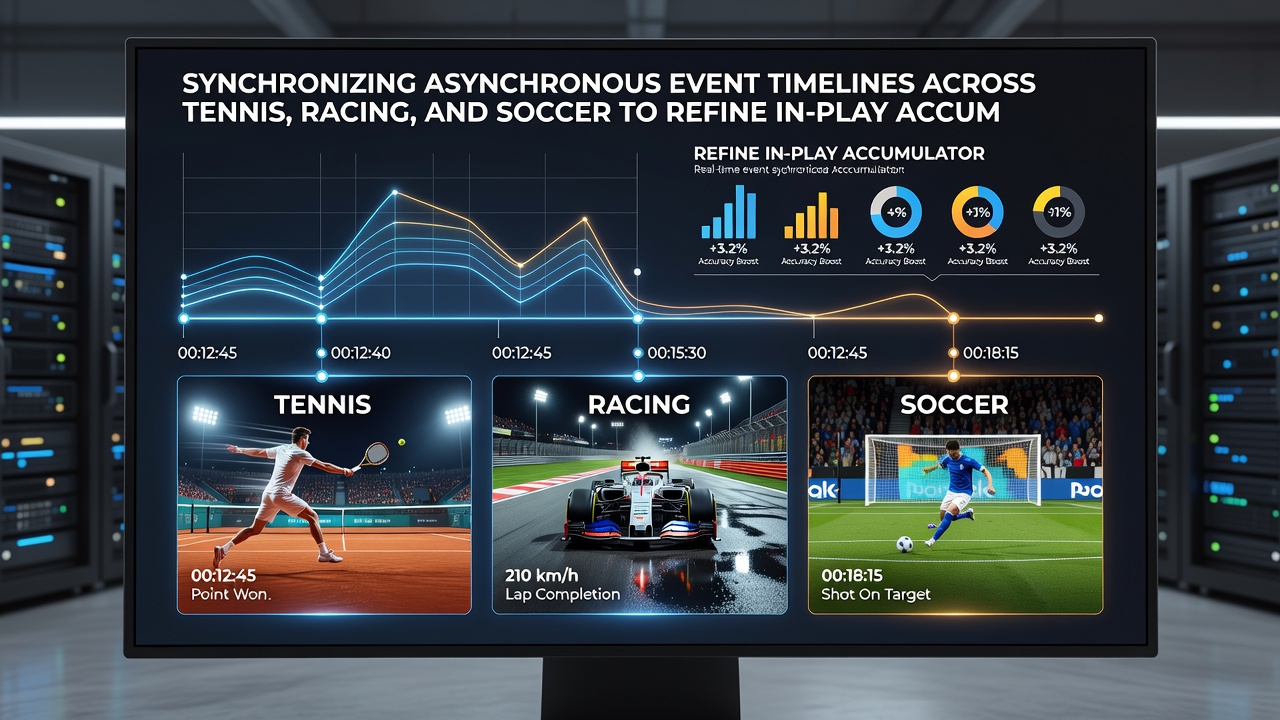
Those who have reviewed operational logs from betting platforms report that synchronized feeds cut the average time required to evaluate a three-leg accumulator from 90 seconds to under 45 seconds during high-volume periods. The same logs highlight that error rates drop when phase markers, such as the end of a tennis tie-break or the final furlong call in racing, trigger automatic re-calibrations for the soccer half-time data stream.
Integration with Accumulator Mechanics
Accumulator entries gain refinement when each leg's probability is recalculated against a common timeline rather than isolated clocks. Analysts at the European Gaming and Betting Association have compiled datasets showing that time-aligned models improve the accuracy of implied probabilities by 12 to 18 percent compared with unsynchronized baselines. The process involves mapping the current state of each event onto a shared axis, then applying conditional weighting that accounts for remaining duration in tennis sets, distance left in races, and minutes remaining in soccer matches.
Platforms that offer these tools typically embed the synchronization layer inside the live betting interface, so users see a single progress bar or clock that represents all active legs. Short pop-up alerts notify when one timeline drifts beyond tolerance, prompting a manual review or automatic pause on further accumulator modifications until alignment is restored.
Future Refinements and Data Sources
Continued development draws on research from institutions such as the Massachusetts Institute of Technology Sports Lab, which explores graph-based models that treat each sport's timeline as a node network linked by shared temporal edges. Early trials suggest these graphs can handle four or more concurrent events without exponential increases in computational load. Regulatory bodies in several jurisdictions, including the New Jersey Division of Gaming Enforcement, have begun requiring operators to disclose the synchronization methods used for multi-sport products, thereby increasing transparency around how in-play accumulator entries are constructed.
Conclusion
Coordinating asynchronous timelines across tennis, racing, and soccer supplies a clearer foundation for in-play accumulator decisions by reducing timing mismatches and presenting concurrent event states on a unified scale. As August 2026 calendars bring more overlapping fixtures, the technical methods already in use continue to evolve through algorithmic refinements and expanded data partnerships, supporting more consistent evaluation of cross-sport betting opportunities.